
Transport
Getting around
Dubai
A driverless metro, a tram through the Marina, and taxis everywhere. What works, where it runs, and what to know at the airport.
Metro and tram
The rail network
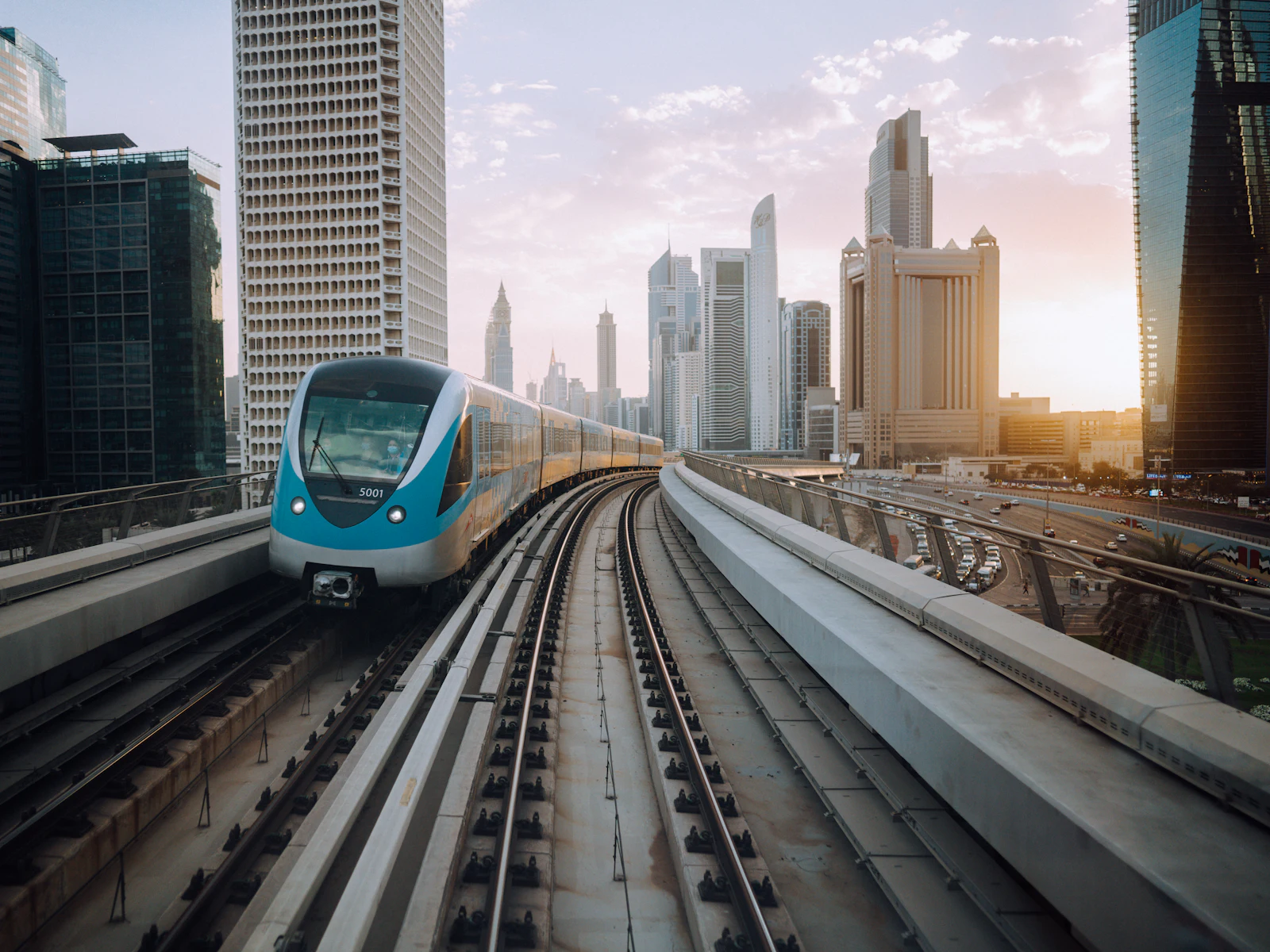
The Red Line runs the length of the city, from Centrepoint (formerly Al Rashidiya) to Jebel Ali. It stops at the airport (Terminals 1 and 3), in Downtown for the Burj Khalifa and Dubai Mall, at Mall of the Emirates and in the Marina.
The tram has 11 stops across the Marina, JBR and JLT. It connects to the metro, and to the Palm monorail through a covered bridge.
The metro is clean, air-conditioned and cheap, and it is often faster than a car along the main corridor. What it does not do is reach most beaches and resorts, which is where a taxi becomes necessary.
Tickets
The Nol card
A single Nol card works on the metro, the tram, the buses and some of the water transport. You buy it at the ticket offices in the stations.
Fares are by zone, and the Gold cabin at the front of the train costs roughly double the standard fare for a noticeably emptier carriage at rush hour.
Taxis and the airport
Cars and arrivals
RTA taxis run on the meter. The Careem app books an official RTA taxi without surge pricing; Uber also operates in Dubai.
At DXB, Terminal 3 is Emirates and Terminal 2 is flydubai — worth checking before you set off, because the terminals are far apart and moving between them takes time.
If you would rather not deal with any of this on arrival, we arrange private transfers with a driver waiting for you at the gate, priced by vehicle rather than per person.
Full guide
Everything worth knowing
Nol cardWhich Nol card suits visitors
The Nol card is how you pay on Dubai's metro, tram and buses. There are four types, and three are relevant to visitors:
- Red ticket (paper): for occasional riders. You can load up to 10 single trips onto it, and it is bought from the ticket machines in the stations, which operate 24 hours. Suits anyone planning only a few metro journeys.
- Silver card: a smart card with an electronic wallet you top up. You get one immediately at any ticket office in a station. Suits anyone travelling a lot, or a family where everyone needs their own card.
- Gold card: like the silver one, but it lets you sit in the Gold Class carriage, with wide leather seats and a panoramic view, at a higher fare.
- Blue card: a personal card with a photo and details. Usually not needed for a short trip.
Where to buy: at DXB you can buy a Nol card at the ticket offices and machines in the metro stations of Terminal 1 and Terminal 3. You can top up at stations or on RTA's nol website.
Important: on buses you can only pay with a Nol card, not cash. So even if you plan to travel mainly by taxi, it is worth keeping one in your pocket, in case of a bus or tram ride.
MetroHours, luggage and the rules on the metro
Operating hours for the metro: Monday to Thursday and Saturday 5:00–24:00, Friday 5:00–01:00, and Sunday 8:00–24:00. Pay particular attention to Sunday: the metro only starts running at 8:00. Anyone with an early Sunday flight needs a taxi. On public holidays and during major events the hours can change.
Luggage: you may board with at most two suitcases, including hand luggage. One large case up to 81×58×30 cm and one small case up to 55×38×20 cm. Luggage goes in the designated areas of the carriage.
Rules worth knowing:
- Eating and drinking are not allowed where it is prohibited, including on the trains, and there are fines. Keep your water bottle closed until you leave.
- Smoking is not allowed on public transport or in its facilities.
- There are carriages for women and children only, and a Gold Class carriage for gold card holders. Men travelling with family board a regular carriage together.
- Let passengers off before you board, and move into the carriage.
The metro has Wi-Fi, lifts and wheelchair spaces. For route planning, the RTA offers the S'hail app, which links the metro, buses, taxis and attractions.
Taxis and appsTaxis in Dubai: travelling without surprises
Taxis are the most convenient way to reach areas the metro does not serve, such as Jumeirah, most of Palm Jumeirah and the desert departure points. There are three main options:
- Official RTA taxi: runs on a meter. At DXB, official taxis are available 24/7 at the marked ranks at every terminal.
- Careem: in the app you can order an official RTA taxi, with no surge pricing.
- Uber and Bolt: operate as well. At the airport there are marked pick-up points for apps.
Tips for a smooth ride:
- Keep the hotel name in English and its location on a map on your phone. Easy to show the driver.
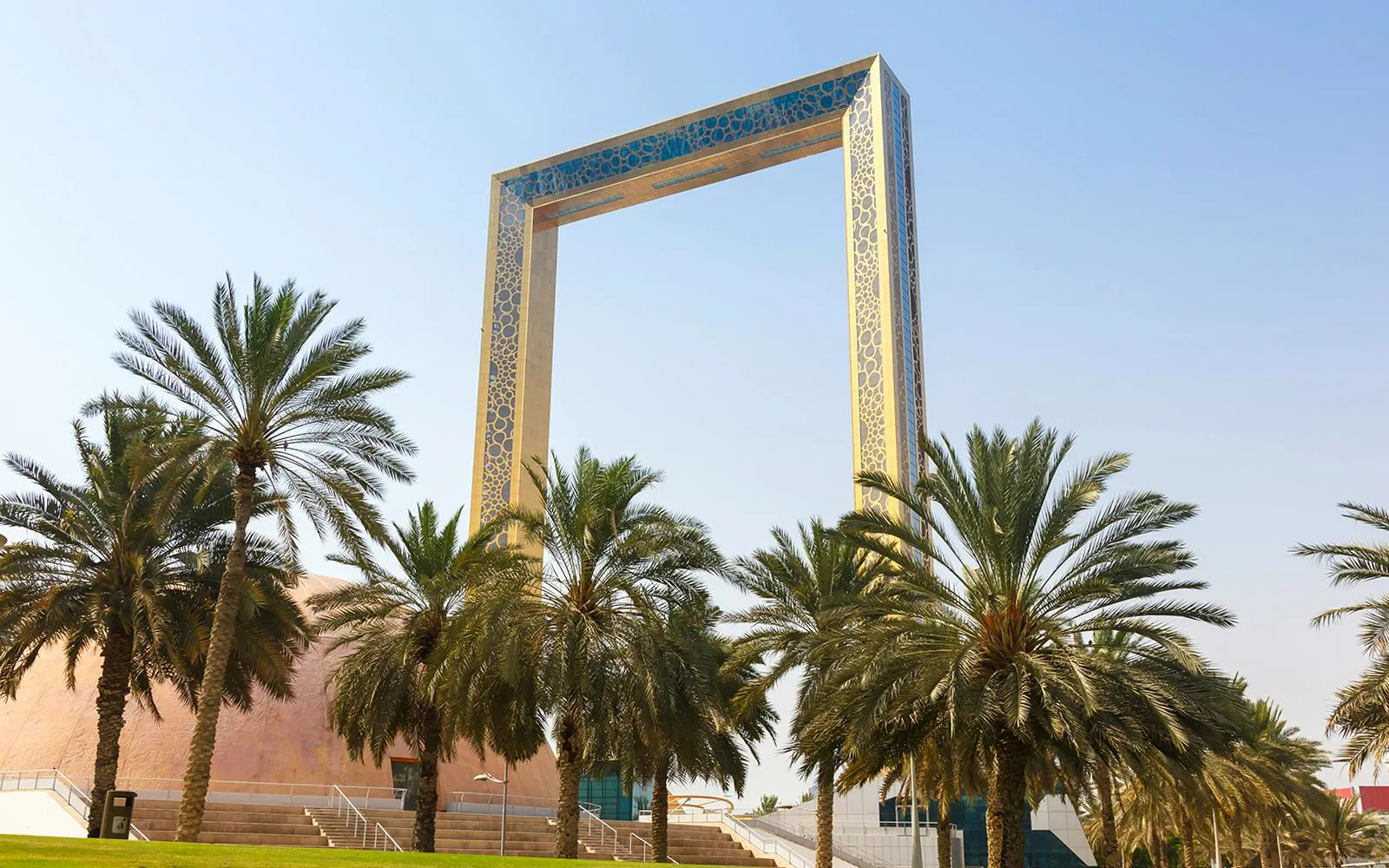
- Heading to an attraction, check in advance which gate or entrance to use. At Dubai Frame, for example, entry is through Gate 4 of Zabeel Park.
- In rush hour, journeys between areas take longer. It is about 23 km from the Marina to Downtown.
Taxis for women and families: at Al Maktoum airport (DWC) there are pink-roofed taxis driven by women, intended for women and families.
And if you would rather the driver was waiting for you on landing, see the airport transfer page.
Tram and monorailThe Marina, JBR and the Palm without a taxi
Around the Marina and JBR, the tram is a convenient way to move between the hotels, the beach and the promenades. It has 11 stops in the Marina, JBR and JLT, and it connects to the metro's Red Line. The tram also takes the Nol card.
The Palm Monorail runs the length of the palm-shaped island. The Atlantis Aquaventure station is next to the entrance to the water park, and the line reaches Palm Gateway station, where you can transfer to the Dubai Tram. That means you can get from the Marina to Atlantis on public transport, without a taxi.
A sample route, from the Marina to Aquaventure:
- Board the tram at the stop nearest your hotel.
- Get off at the stop that connects to Palm Gateway.
- Transfer to the monorail and ride to the Atlantis Aquaventure station.
It takes longer than a taxi, but it gives you a fine view of the Palm from above, and suits children who like trains. Before you travel, check the monorail's site for payment methods and operating hours.
Anyone staying in this area will find details of the hotels on the Hotels and areas page. And anyone staying in Downtown can reach the Marina on the metro's Red Line and continue by tram.
Families and accessibilityGetting around with children, pushchairs and a wheelchair
Public transport in Dubai is relatively comfortable for families and for wheelchair users. Here is what to know:
- Accessibility on the metro: stations have lifts and carriages have designated wheelchair spaces. There are also security cameras and help points.
- Women and children carriage: mothers travelling with children can sit in the carriage designated for women and children only. A family travelling together, with a father, boards a regular carriage.
- Accessible taxis: at Abu Dhabi airport there are larger vehicles and wheelchair-accessible vehicles.
- Pushchairs at attractions: not every attraction allows pushchairs inside. At Dubai Frame, for example, pushchairs and luggage are left at Gate 4.
- Late evenings: on Friday the metro runs until 01:00, and on other days until midnight. Anyone coming back later, with tired children, will prefer a taxi.
A tip for families: for short journeys in the city, one taxi for the whole family can be simpler than the metro with changes. For journeys along the Red Line, from Al Barsha to Downtown for example, the metro beats the traffic. And getting from the airport to the hotel with children and luggage is easier in a private transfer waiting for you on landing.
To the attractionsHow to reach the main attractions
Some Dubai attractions sit right on the metro line, and some need a bus or a taxi. Here is what we checked:
- Burj Khalifa and the Dubai Mall: the Red Line stops in Downtown, next to the Burj Khalifa and the Dubai Mall.
- Dubai Frame: entry through Gate 4 of Zabeel Park. The nearest metro station is Max (formerly Al Jafiliya).
- Global Village: buses 102, 103, 104 and 106 go there.
- Mall of the Emirates and Ski Dubai: there is a Red Line station.
- Legoland and Dubai Parks: there is an RTA bus route from Ibn Battuta metro station.
- Creek cruises: old Dubai is served by both metro lines, and Union and BurJuman are the interchange stations.
- Desert safari: usually includes hotel pick-up, so no transport is needed.
- Abu Dhabi: an organised tour or a private car are the most convenient. The Airport Express bus to Abu Dhabi airport also leaves from Ibn Battuta.
Tip: before you set out, check the full route in S'hail, including the walking time from the station. In summer, even 10 minutes of walking in the sun feels long.
On the waterAbra, ferry and water taxis: the finest way to travel
Not every journey in Dubai has to be on a road. The RTA also runs marine transport, and some of it is an experience in itself, not just a way to get somewhere.
The abra on the Creek
These traditional wooden boats have crossed Dubai Creek for decades, between Bur Dubai and Deira. It is one of the shortest and cheapest rides in the city, and the most natural way to move between the souks on either side of the water. It is worth keeping a little cash in dirhams, and checking at the jetty which payment methods are accepted. You can also hire an abra for a short private cruise along the Creek. A guided tour that includes the alleys and the boat ride: Old Dubai and an abra ride on the Creek, from 86 AED per person.
The Dubai Ferry
The Dubai Ferry connects stations along the coast and the Creek, among them the Marina and old Dubai. It is a quiet, pleasant way to see the skyline from the water, especially in the afternoon. Check the timetable and the stations on the RTA site or in S'hail, as they change by day and season.
Water taxis and the Dubai Canal
The RTA also runs water taxis, booked in advance, and marine routes along the Dubai Canal, which links Business Bay to Jumeirah beach. These are less a daily means of transport and more a pleasant way to end the day.
And if you want a real cruise
An evening cruise on a traditional dhow, with dinner, in the Marina or on the Creek, is one of the most popular evenings in Dubai. Cruises and yachts start at 68 AED per person.
Hire carHiring a car in Dubai: when it is worth it
Dubai's roads are wide, orderly and well lit, and driving is on the right. Even so, for most travellers staying in the city, a hire car is not necessary. Here is when it is worth having one.
When a hire car makes sense
- Trips outside the city: Hatta, Ras Al Khaimah or the east coast.
- A large family travelling a lot between areas the metro does not reach.
- Anyone staying at a remote resort who wants independence.
When you are better off without
Within the city, between Downtown, the Marina and the Palm, taxis, metro and tram are usually simpler. Parking in the central areas costs money and takes time, and in rush hour the traffic is heavy.
What to know before you drive
- Licence: the requirements for visitors vary. Check with the hire company, before booking, which documents are needed and whether an international driving permit is required.
- Road tolls (Salik): Dubai's main roads have automatic toll gates. Do not stop and do not pay on the spot: the charge is recorded automatically and passes to the hire company, which bills you.
- Speed cameras: there are many, and the fines are high. Drive to the signs.
- Zero tolerance for alcohol: do not drive after drinking, not even one glass.
- Courtesy on the road: angry hand gestures and horn use can count as a genuine offence.
A private driver instead of a hire car
For anyone who wants independence without driving, a car with a driver for a full day is a comfortable solution, especially for day trips. For the journey between Dubai and Abu Dhabi there is a private transfer, from 375 AED per vehicle.
On footWalking in Dubai: where it works and where it does not
Dubai was not built for pedestrians. The distances are large, the roads are wide, and for much of the year it is too hot. But there are several areas where walking is exactly the right way to experience the city.
The best places to walk
- The Marina promenade: a long route along the water, between the towers, with restaurants and cafés. Especially fine in the evening.
- JBR: a pedestrian street by the beach, with shops and restaurants, and a view of the observation wheel.
- The Downtown boulevard: a route around the Burj Khalifa, with a view of the fountains.
- Al Fahidi and Al Seef: the historic alleys and the promenade along the Creek. Here the walking is the experience.
- City Walk and La Mer: open areas with shops, restaurants and a relaxed atmosphere.
Air-conditioned walkways
Many metro stations are connected to malls and towers by covered, air-conditioned walkways. From the Burj Khalifa/Dubai Mall station, for instance, a long air-conditioned bridge leads straight into the mall. In summer, those walkways are what let you get around without arriving exhausted.
Walking tips
- Check the distance in advance. What looks close on a map can be a half-hour walk around a motorway.
- Cross only at crossings. Crossing where it is not allowed can bring a fine.
- In the hot months, plan walks only for early morning and after sunset.
Between the EmiratesFrom Dubai to Sharjah, Abu Dhabi and the north
One of the advantages of a Dubai holiday is how easily you can head out to the neighbouring emirates. Here is how to get there, by destination.
Sharjah
Sharjah adjoins Dubai, and the distance between them is short. The problem is traffic: during the morning and afternoon peaks, the drive on the connecting roads can take far longer than expected. Go in the middle of the day or at the weekend, by taxi or on an RTA intercity bus. Sharjah's attractions, such as Al Noor Island and Sharjah Safari, are especially convenient by car.
Abu Dhabi
An hour and a half to two hours on the motorway. There are several options:
- An organised tour: the simplest, with hotel pick-up. A day trip to Abu Dhabi starts at 98 AED per person.
- A private transfer: a car with a driver, from 375 AED per vehicle. Booked at least a day in advance.
- Bus: there are intercity routes, and the Airport Express bus from Ibn Battuta to Abu Dhabi airport.
Ras Al Khaimah and the north
Ras Al Khaimah is about an hour to an hour and a half north, depending on traffic. Jebel Jais and the zipline and Al Marjan Island are there. For these, a private car or an organised tour are far more convenient than public transport.
Hatta and Fujairah
A trip to the mountains or the east coast is a full day. A day trip to Hatta and snorkelling with sea turtles in Fujairah both come with an option that includes transport from Dubai, which settles the transport question entirely.
Common mistakesCommon transport mistakes, and how to avoid them
Most travellers have Dubai's transport figured out by the second day. These are the mistakes worth avoiding from day one.
Forgetting to tap out
The metro and tram charge by zone, so you tap your Nol card both on entry and on exit. Anyone who forgets to tap out may be charged the highest fare.
Setting out with no balance
You need a minimum balance on the card to enter the metro. Top up at the start of the day, so you are not stuck in the machine queue at rush hour.
Boarding the wrong carriage
The first carriage of the train is divided: part for women and children only, and part for Gold Class. Men who board the women's section by mistake can be fined. The signs on the platform and in the carriage are clear, and it is worth looking at them.
Drinking in the carriage
Even a sip from a water bottle on the train is not allowed. Keep the bottle closed until you leave the station.
Trusting the map without checking the distance
A metro station that looks close to an attraction can be a long walk away, sometimes without a convenient crossing. Check the walking time in S'hail, and in summer take a taxi for the last stretch.
Planning a day that crosses the whole city
The biggest mistake of all: morning in the Marina, midday in Deira and evening on the Palm. Plan each day around one or two nearby areas, and you will gain hours. The breakdown of the areas, and where to stay accordingly, is on the Hotels and areas page.
A sample dayA full day in Dubai on public transport
You can see a great deal of Dubai without a single taxi. Here is a sample day, from old Dubai to Downtown, by metro and abra, best suited to the comfortable season.
Morning: old Dubai
Take the metro to the Creek area, and wander the Al Fahidi alleys and the Al Seef promenade while it is still pleasant. Cross the Creek by abra to the Deira side, and explore the souks. On the way back, another abra, and from there to the metro.
Midday: Dubai Frame
Ride to Max station (formerly Al Jafiliya), and walk to Gate 4 of Zabeel Park. Dubai Frame, from 71 AED per person, shows you the old city you visited in the morning on one side, and the new skyline on the other.
Afternoon: Downtown
Continue on the Red Line to Burj Khalifa/Dubai Mall station, and take the air-conditioned bridge straight into the mall. This is a good time to rest, eat and visit Dubai Aquarium.
Evening: Burj Khalifa and the fountains
Go up to the viewpoint at the Burj Khalifa towards sunset, and come down to watch the free fountain show from the promenade. From there, the metro takes you back to your hotel.
A day like that works well with one Nol card each. All the attractions, with directions, are on the What to do in Dubai page. And anyone looking for the full three-day route will find it in the 3 days in Dubai guide.
What to chooseMetro, taxi or transfer: what suits each journey
No single mode of transport suits every journey in Dubai. Here is a short guide, by the situation you are in.
Travelling along the Red Line
From the Marina or Al Barsha to Downtown, or from Downtown to old Dubai: the metro is fast, air-conditioned, cheap and skips the traffic. In the morning and afternoon rush hours, it is usually faster than a taxi.
Travelling to Jumeirah, the Palm or an area without a station
A taxi or an app. You can also combine the two: the metro to the nearest station, and a short taxi ride for the last stretch. In summer, this is the option that saves you walking in the sun.
A family with small children
For short journeys, one taxi for the whole family is simpler than the metro with changes. For long journeys along the line, the metro is convenient, with lifts and room for a pushchair.
To and from the airport
With one or two suitcases, and no time pressure, the metro from Terminal 1 or 3. With more luggage, with children, at night or from Terminal 2, an official taxi or a private transfer, from 100 AED per vehicle on arrival.
An evening out
The metro runs until midnight, and on Friday until 01:00. After that, a taxi. On busy evenings, such as weekends around Downtown, the wait for a taxi can run long, so it is worth booking through an app.
Day trips
Safari, Hatta, Abu Dhabi: usually with transport included. If not, a private car with a driver is the convenient option.
Frequently asked questions
Which Nol card should a visitor buy?
What time does the metro open on Sunday?
Can I pay cash on a bus in Dubai?
How much luggage can I take on the metro?
Are there taxis for women in Dubai?
How do I get to Global Village on public transport?
How do I get from the Marina to Atlantis without a taxi?
Is it worth hiring a car in Dubai?
What is Salik in Dubai?
How do I cross the Creek in Dubai?
Is there a ferry in Dubai?
Can you walk around Dubai?
Does the metro reach Palm Jumeirah?
Does the metro reach Dubai airport?
How do I travel from Dubai to Sharjah?
How do I get from Dubai to Abu Dhabi without a car?
Do I need to tap my Nol card when leaving the metro too?
Is there Uber in Dubai?
Keep exploring
More experiences in Dubai





Where to stay
Recommended hotels in Dubai






The perfect combination
Also in Abu Dhabi





Plan smart
From the magazine


More inspiration